En

 Download ParkUsher Free
By Ali Ziarizi, Co-Founder of ParkUsher | Published: April 2, 2026 | Updated: April 2, 2026
Street parking in San Francisco in 2026 comes down to a few big rules: most parking meters run from 9 a.m. to 6 p.m. Monday through Saturday, curb colors each mean something different, residential permit zones limit non-permit parking, and San Francisco still enforces basics like the 72-hour rule, commute-hour tow-away restrictions, and hill parking laws. On top of that, meter prices are demand-responsive, which means rates can change by block and time of day instead of staying fixed citywide.
Of course, that's the calm version. The real version is that you find a spot in the Mission, SoMa, North Beach, or the Castro, feel a flicker of hope, then look up and realize the curb has more rules than a medieval guild.
This San Francisco parking guide breaks down the SF parking rules that matter most, from meters and permits to hills and tow-away windows. If you want more local context on when ParkUsher launched in San Francisco, this guide picks up where that story left off. You can also explore broader San Francisco parking coverage before you head out.
San Francisco packs a lot of parking stress into a very small amount of curb. You've got hills, dense neighborhoods, meter rules that change by location, permit zones, loading zones, and commute-hour tow-away periods that can turn a perfectly fine-looking space into a very expensive mistake. SFMTA's own parking guidance warns drivers to read every sign on the block because restrictions can vary by day, time, and exact curb location.
That's why the city feels tricky even when you technically know the rules. It's not that the rules are impossible. It's that they pile up. You're driving, watching traffic, watching cyclists, trying not to get honked at on a hill, and simultaneously trying to decode whether this curb is metered, residential, loading-only, or secretly preparing to tow you during rush hour.
It's like urban sudoku, except the penalty for getting it wrong is not inner growth.
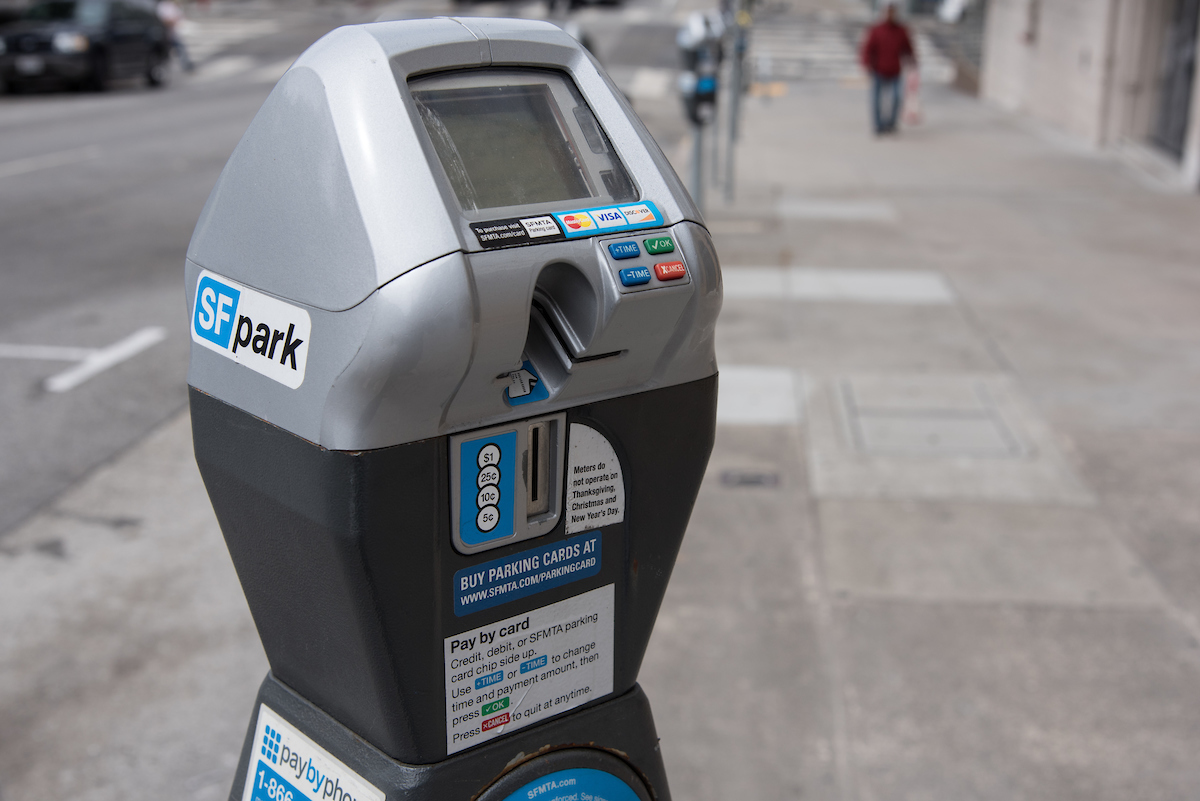
SFMTA says most San Francisco meters are enforced from 9 a.m. to 6 p.m. Monday through Saturday, but the city immediately adds the fine print that hours and rates vary, so you should always check the meter face. Meters generally operate every day except Thanksgiving, Christmas Day, and New Year's Day.
There are also exceptions that catch people off guard. SFMTA says some Sunday meter operation exists in Fisherman's Wharf, The Embarcadero, several off-street lots, and the special event area around Oracle Park and Chase Center. Some neighborhoods also have meters that run later than 6 p.m.
So yes, "meters are 9 to 6" is a decent starting point. It is not a religion. In San Francisco, the meter itself is the final boss.
San Francisco uses demand-responsive parking pricing, which means the city adjusts meter prices based on how full a block tends to be. SFMTA says the goal is to maintain the right level of parking availability by matching rates to demand, encouraging people to use underutilized blocks and helping open up spaces in busy areas.
Under the current Transportation Code language approved in 2025, SFMTA's citywide variable meter rates are set between $1.00 and $13.00 per hour, effective July 1, 2025, and the Director of Transportation may adjust rates for particular meters and times not more than once every 28 days. The code also describes the occupancy-based formula: if estimated occupancy is greater than 80%, rates go up by $0.25/hour; if it's between 60% and 80%, rates stay the same; and if it's below 60%, rates go down by $0.25/hour.
That sounds scary at first glance, but most drivers are not paying $13 an hour on a quiet residential block. In practice, most neighborhood meters sit much closer to the lower end of the range, while the top end is aimed at very high-demand areas and peak blocks like Fisherman's Wharf, the Embarcadero, and event-heavy zones near Oracle Park.
In other words, the city is not trying to make every meter brutal. It is using SFMTA parking regulations to price the busiest curb space higher when demand gets ridiculous.
One more thing: SFMTA's current code also says mobile parking payments now carry a $0.35 convenience fee as of July 7, 2025, with authority to increase slightly beyond that.
If you are trying to budget realistically, it helps to think about meter pricing by area, not just by city.
In the busiest visitor and destination zones, like the Embarcadero, parts of Fisherman's Wharf, and around Oracle Park, the meter can feel aggressively expensive because demand stays high for long stretches of the day. These are the blocks where San Francisco is most likely to push rates upward.
In neighborhoods with mixed residential and commercial use, like the Mission or parts of North Beach, meter pricing tends to feel more moderate, but the real issue is that availability gets eaten up fast. You are not just dealing with price. You are dealing with turnover pressure.
In calmer neighborhood zones or on quieter edges of residential-commercial districts, meter prices are usually much less dramatic. That is where San Francisco's demand-based system makes more sense: the city is trying to keep one or two spaces open on a block, not price every single curb like it is a luxury commodity.
San Francisco's curb colors matter a lot, and they're one of the easiest ways to get burned if you only half-read them.
Red curbs mean no parking at any time. SFMTA's parking guide is extremely direct on this point: do not park in a red zone.
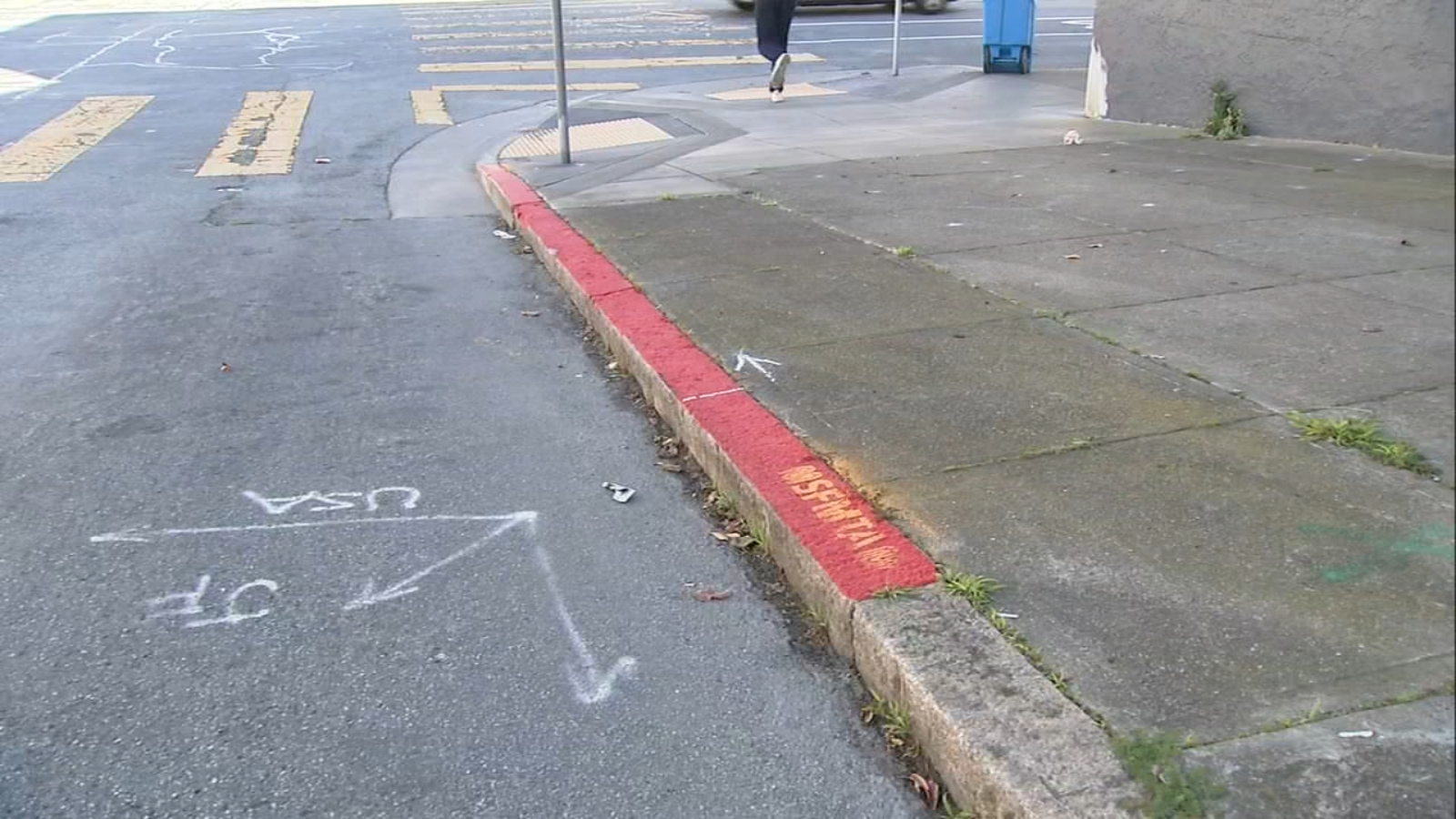
Yellow curbs are for commercial vehicles actively loading or unloading freight. Nearby signs or curb stencils tell you the effective hours, and non-commercial vehicles parked there can be cited and, in some cases, towed.
White curbs are for passenger loading and unloading during certain hours, typically with a five-minute limit, and the driver usually has to remain with the vehicle. Some white zones are restricted to certain vehicle types, like taxis or tour buses.
Green curbs are for short-term parking. SFMTA's parking guide says they generally do not exceed 10 minutes, though in metered areas green meters may have a 15- or 30-minute time limit.
Blue curbs are reserved for vehicles with a valid disabled parking placard or license plate and are effective 24/7, though SFMTA notes they can still be affected by tow-away or special event restrictions.
This is the important part: curb color gives you the category, but the sign or meter gives you the exact rule. The curb is the headline. The sign is the terms and conditions.
San Francisco's Residential Parking Permit program exists to make it easier for residents to park in their own neighborhoods by putting time limits on non-resident parking. SFMTA says that if you live in an RPP area, a residential permit exempts you from the posted time limit for that area. Most addresses may purchase up to four permits, though areas AA, EE, and HV are limited to two.
This is where people overestimate what a permit does. An RPP permit helps with the posted residential time limit. It does not wipe out everything else. SFMTA says permits do not exempt drivers from the 72-hour rule, from paying on metered blocks that are not signed as pay-or-permit, or from color curb restrictions like tow-away, passenger loading, or commercial loading zones.
So if you've got an RPP permit and think you've unlocked god mode, San Francisco would like a word.
San Francisco follows California's 72-hour rule. SFMTA says a vehicle is only allowed to park in the same spot on a public street for up to 72 hours, and a vehicle parked beyond that may be issued a warning, cited, and/or towed, even if it has a residential permit for that area. SFMTA also says disabled placards do not exempt a vehicle from this rule.
The agency explains that enforcement is complaint-driven: a complaint triggers an inspection, starts the clock, and if the same vehicle is still there 72 hours later, enforcement can follow.
That rule matters a lot in residential neighborhoods and on calmer outer blocks where people assume the curb is basically long-term storage. It is not. It is still public street parking, not your private museum exhibit.
San Francisco and hills go together like fog and people pretending it's not that cold. SFMTA says drivers must curb their wheels when parking on a slope greater than 3 percent, and the safest habit is to do it every time you parallel park because few of us are walking around with a street-grade calculator.
If you're facing downhill, turn your front wheels toward the curb. If you're facing uphill, turn your front wheels away from the curb and let the vehicle roll back until the wheel gently touches the curb. SFMTA also recommends setting the parking brake, and California DMV guidance matches that basic uphill-versus-downhill wheel logic.
SFMTA also notes that when parking parallel, the wheels closest to the curb must be within 18 inches of it.
This is not optional San Francisco trivia. This is one of those rules that sounds quaint until your car decides to audition for an action movie.
San Francisco has plenty of spots that look legal until commute hours begin. SFMTA says some parking zones become tow-away zones during commute hours, including some metered spaces, and drivers need to check the meter face and nearby signs for the exact restriction.
This matters most on busy corridors and near major traffic routes, where the curb changes purpose depending on the time of day. A spot that's totally fine in the middle of the afternoon can become a tow-away problem during the morning or evening rush.
And unlike some lesser parking sins, this one can escalate very quickly. San Francisco does not care that you were "just going to be ten minutes."
Street parking in San Francisco gets much easier when you stop thinking only in neighborhoods and start thinking in specific street types. The busiest commercial corridors are almost always the hardest, and the quieter residential side streets are almost always the better bet.
If you want one of the friendlier parking areas in the city, the Outer Sunset is usually a better bet than the dense northeast core. Residential avenues west of 19th Avenue and quieter side streets off Noriega Street and Irving Street often feel much more manageable than tighter commercial stretches closer to Golden Gate Park.
In the Richmond, the broad rule is simple: the commercial parts of Clement Street, Geary Boulevard, and Balboa Street get much tighter than the surrounding residential grid. If you are willing to park a few minutes away and walk, the side streets off those corridors are often a lot less painful.
The Mission is one of those neighborhoods where the main streets are the problem. Valencia Street is heavily metered and full of activity. Mission Street is even more chaotic, with bus traffic, commercial pressure, and constant demand. If you are trying to park here, the calmer move is often to start on quieter residential side streets away from the hottest retail stretch.
North Beach gets rough fast around Columbus Avenue, Broadway, and the densest restaurant blocks. If you want a better shot, the quieter residential stretches around streets like Greenwich or Filbert can be more realistic than fighting the busiest core.
SoMa is where people underestimate how fast the curb gets complicated. Around Townsend Street, 1st Street, Mission Street, and event-heavy areas near Oracle Park, parking gets competitive and rule-heavy very quickly. If you are searching here, it helps to move farther away from the busiest office and event corridors instead of insisting on the perfect front-door space.
The pattern is consistent across the city: busy commercial corridors are where hope goes to die, and quieter residential side streets are where patience actually pays off.
Usually, metered street parking is not enforced on Sundays, but San Francisco has enough exceptions that you should not assume every curb is automatically free. Some areas and facilities can still operate differently, so the safest move is always to check the meter and nearby signs before you walk away.
Meter prices vary by block and demand. The official citywide range is $1 to $13 per hour, but most residential and lower-demand areas sit much closer to the low end. The highest rates are reserved for the most competitive blocks in high-demand zones.
Red means no parking. Yellow is for commercial loading. White is for passenger loading. Green is short-term parking. Blue is reserved for disabled placard parking. The curb color gives you the category, but the sign or meter tells you the exact rule.
You generally cannot leave a vehicle in the same spot on a public street for more than 72 hours. If someone reports the vehicle and it is still there after the city's inspection timeline runs out, you can be cited or towed.
Not always. You only need an RPP permit if the block is in a residential permit zone and you want to stay beyond the posted non-permit time limit. Even with an RPP permit, you still have to follow meter rules, color curbs, and the 72-hour rule.
Best case, you get a ticket. Worst case, your car is gone when you come back. That is why commute-hour tow-away signs are some of the most expensive mistakes in the city.
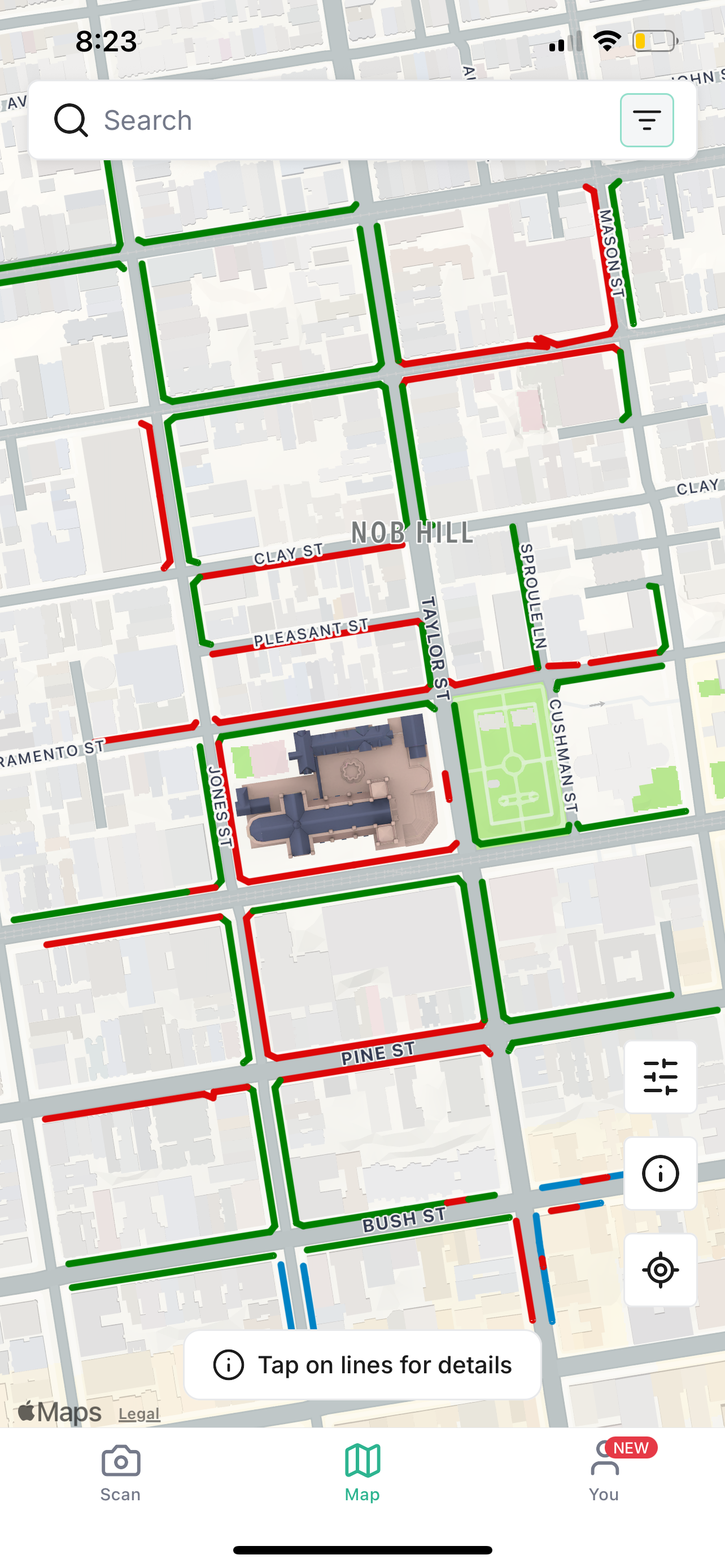
If you want to see how ParkUsher's real-time map works in more detail, the short version is simple: it turns complex curb rules into something much easier to act on while you are actually driving.
The real-time parking map shows you exactly where legal street parking is available, down to each side of the street. In San Francisco, that matters because one side of the block can be fine while the other side is a meter, a loading zone, or a tow-away trap waiting for commute hours to kick in.
No guesswork. No squinting at signs. No gambling on a ticket.
You simply follow the map straight to legal parking, like finding the pot of gold at the end of a rainbow that happens to be on a 14 percent grade.
And yes, it updates in real time.
When you're actively looking for parking, Driver Mode centers the map on your location and keeps you centered as you move. Instead of crawling around San Francisco trying to decode every sign while also dealing with hills, buses, and people crossing wherever they feel spiritually called to do so, you simply follow the legal parking on the map.
It turns the most frustrating part of city driving into something much more manageable. Instead of scanning every block equally, you focus on the streets where you've actually got a shot.
Stop gambling on SF parking. ParkUsher shows you what's legal, right now — Download on iOS | Get it on Android
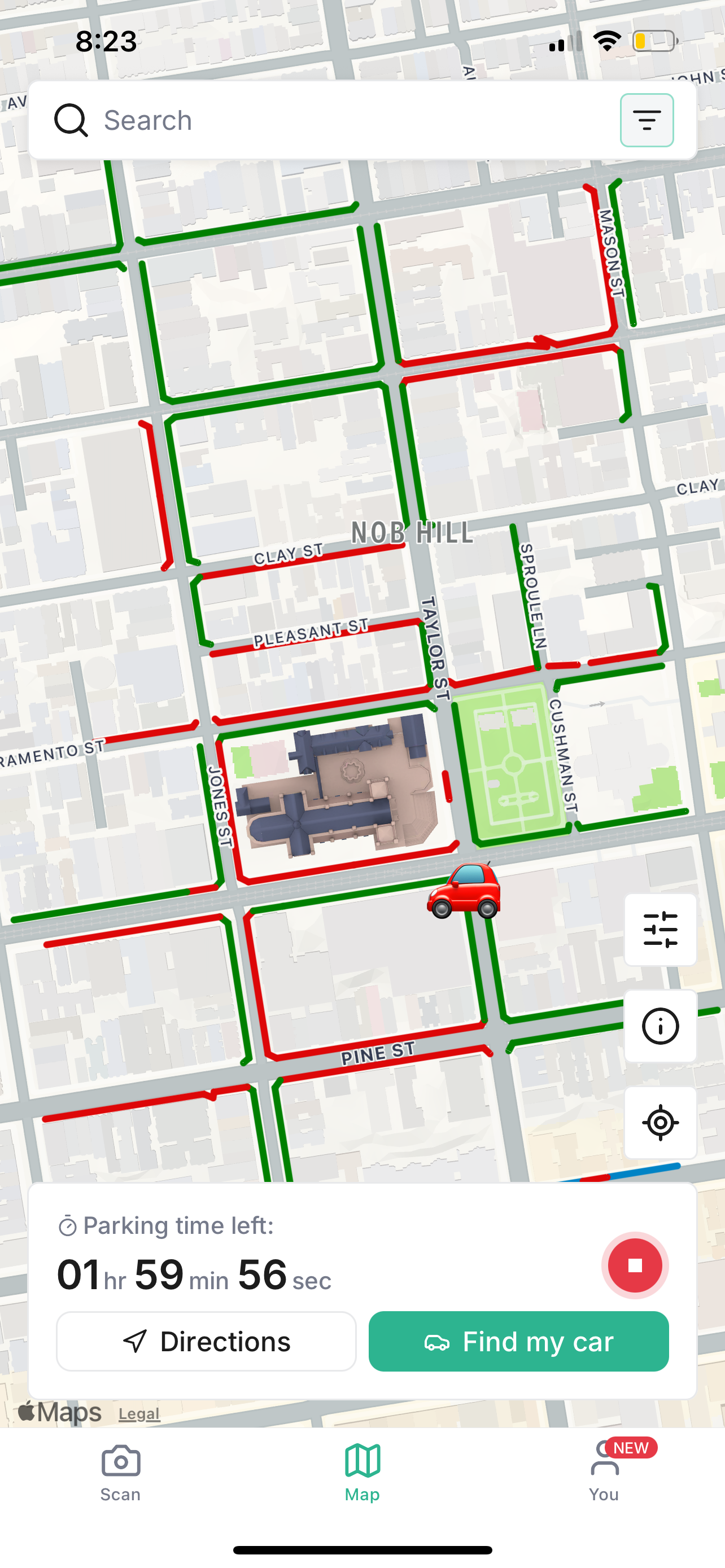
Found a parking spot? Tap Pin & Notify Me.
ParkUsher lets you pin your parking spot and get a notification when it's time to move your car. As a bonus, your car's location is saved, so you're not wandering around SoMa later trying to remember whether you parked near the coffee shop, the mural, or the suspiciously expensive sandwich place.
That's especially useful in San Francisco because even when you've parked legally, your work isn't always over. Between meter limits, residential limits for non-permit drivers, and block-by-block restrictions, forgetting the time can still ruin your day. If you want more planning tools and paid-parking filters, that's where ParkUsher Pro comes in.
Before you leave your car in San Francisco, run through these:
If that sounds like a lot, that's because it is.
Street parking in San Francisco in 2026 isn't impossible. It's just specific. Once you understand the curb colors, the meter hours, the demand-based pricing, the RPP limits, the 72-hour rule, the hill-parking law, and the commute-hour tow-away setup, the city starts to feel a lot less random. The official SFMTA rules are all there. The hard part is using them in real life, in real time, on a real block, while your brain is doing six other things.
That's where ParkUsher helps. Instead of turning every parking attempt into a curbside legal exam, you can check the map, see what's legal right now, and head straight to the spots that actually make sense for your trip.
Navigate SF parking like a local. Check San Francisco parking and download ParkUsher free on iOS or Android.